
Industrial brush is not a product. It’s a category — and a vague one.
A cup brush and a strip brush share nothing but bristles. One removes weld scale from steel; the other seals dust out of a packaging line. Specify “industrial brush” on a purchase order and you’ll get a conversation, not a quote.
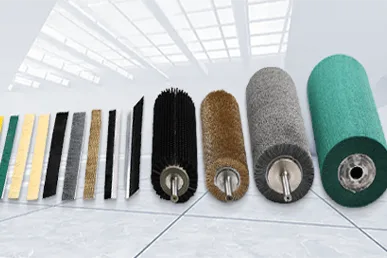
Here are the 10 types that cover most manufacturing floors, and what each one is actually for.
1. Cup Brush
- Shape: Bristles flare outward from a central cup, mounted on an angle grinder or bench motor.
- Used for: Heavy surface prep in one pass — rust removal, weld cleaning, deburring large flat areas.
- Specs that matter: Cup diameter, thread size (M10/M14), and wire configuration. Twist-knot cups cut harder; crimped cups leave a finer finish.
- Application notes: The flared shape distributes contact over a wide area, which is why cup brushes are the default for cleaning weld beads and prepping steel before painting.
2. Wheel Brush
- Shape: A disc with bristles radiating outward.
- Used for: The most versatile brush type — deburring, polishing, light rust removal, surface blending.
- Specs that matter: Diameter, face width, arbor hole, and wire type. Wider faces cover more surface per pass; narrower faces reach into tighter spaces.
- Application notes: Wheel brushes are used everywhere from CNC deburring stations to bench grinders. When in doubt about a brushing task, a wheel brush is usually the starting point.
3. Cylinder/Roller Brush

- Shape: A cylindrical brush that rotates on a horizontal axis — often called a spiral wound or roller brush.
- Used for: Continuous processing. Conveyor cleaning, sheet metal finishing, glass washing, and inline surface treatment.
- Specs that matter: Core diameter, brush outer diameter, face length, and filament. Wound or welded construction determines durability at high RPM.
- Application notes: These are the brushes that run inside production equipment, not at a bench. Specifying them means matching the machine shaft, not just the bristle.
4. Disc Brush
- Shape: Flat circular brush that mounts face-down on a rotating head.
- Used for: Floor scrubbers, polishing machines, and inline deburring on flat parts.
- Specs that matter: Diameter (15″, 16″, 17″, 20″ standard), filament material, and mounting plate type — clutch, center-lock, or universal.
- Application notes: Disc brushes are consumables in commercial cleaning equipment. The bristle spec decides whether the machine cleans or just wets the floor.
5. Strip Brush

- Shape: A linear row (or rows) of bristles held in a metal channel.
- Used for: Sealing, guiding, dust prevention, and wiping. Conveyor guards, door sweeps, machine enclosures, escalator seals.
- Specs that matter: Channel material (stainless, galvanized, aluminum), bristle material, tuft density, and trim length.
- Application notes: Strip brushes are cheap components that cause expensive downtime when wrong. Density controls seal integrity; trim length controls contact pressure.
See our nylon channel strip brush for door sweep and sealing configurations.
6. Tube / Bottle Brush
- Shape: Bristles arranged radially around a twisted wire stem.
- Used for: Internal cleaning and deburring. Cylinder bores, pipe interiors, cross-drilled holes, heat exchanger tubes.
- Specs that matter: Brush diameter, overall length, stem type, and filament. Miniature versions handle holes under 10 mm.
- Application notes: These are precision tools. A tube brush that’s 1 mm oversized won’t enter the bore; undersized won’t contact the wall.
7. End / Face Brush
- Shape: Bristles on the end face of a mounted stem, sometimes called an end brush.
- Used for: Small area deburring, surface prep in tight spots, spot cleaning recessed features.
- Specs that matter: Diameter, trim length, and stem/shank size. Short trim stays stiff for spot work.
- Application notes: When a wheel brush can’t fit, an end brush usually can. It’s the response to access-limited jobs.
8. Twist Knot Wire Brush

- Shape: Heavy-gauge wire twisted into tight knots rather than crimped.
- Used for: Aggressive work — heavy rust, thick weld scale, caked residue, concrete form cleaning.
- Specs that matter: Wire diameter, knot density, and RPM rating. Twist knot brushes cut harder and throw more debris.
- Application notes: Maximum cutting power with minimum flexibility. They also demand full PPE — wire breakage is a real hazard at speed.
See the twist knot wire cup brush for aggressive surface preparation.
9. Crimped Wire Brush

- Shape: Wire crimped into a wavy pattern, giving a flexible, uniform brushing face.
- Used for: Lighter surface work — cleaning, rust dust removal, paint prep, deburring softer metals.
- Specs that matter: Wire diameter and crimp density. Finer wire produces a finer finish.
- Application notes: Crimped wire is the finishing counterpart to twist knot. Where twist knot cuts, crimped wire polishes.
10. Abrasive Nylon Brush
- Shape: Nylon filaments co-extruded with abrasive grain — silicon carbide, aluminum oxide, ceramic, or diamond.
- Used for: Deburring, edge blending, surface finishing, and radiusing — without removing base material or changing part geometry.
- Specs that matter: Abrasive type and grit size. Coarse grits deburr aggressively; fine grits produce near-polished surfaces.
- Application notes: This is where industrial brushing stops being aggressive and starts being precise.
Abrasive nylon is also the most specification-sensitive category in the industry. The filament has to match the workpiece material, the burr size, the desired finish, and the machine’s capability. Off-the-shelf rarely covers it.
That’s why we build a custom abrasive industrial brush to the application rather than to a catalog — filament formulation, grit, density, and core geometry specified to the part being processed. For CNC deburring cells, appliance manufacturing, and aerospace edge finishing, that’s the difference between a process that holds tolerance and one that doesn’t.
How to Choose
Match the brush type to the operation, then specify within it:
| If your task is… | Start with… |
|---|---|
| Weld cleaning, heavy rust | Twist knot cup or wheel brush |
| Light cleanup, paint prep | Crimped wire brush |
| Continuous inline processing | Cylinder / roller brush |
| Sealing and dust control | Strip brush |
| Internal bores and holes | Tube brush |
| Restricted access areas | End / face brush |
| Deburring without material removal | Abrasive nylon brush |
| Floor scrubbing equipment | Disc brush |
Our industrial brush collection covers wire, strip, roller, and polishing configurations — with 110+ patents behind the custom engineering.
Ten types. Each one solves a different problem, and each one fails differently if you pick the wrong one.
The type is the decision. The specs are the execution. Get the type right first — then the rest of the specification work actually pays off.